Standing at the edge of the Grand Canyon, exploring Yellowstone’s volcanic landscape or tracing underground water through Michigan’s forests may sound like the work of seasoned scientists. But for students at the University of Arkansas–Fort Smith, it’s part of earning a college degree.
Ask someone what they thing a geologist does, and they’ll probably picture a scientist examining rocks. But geoscience encompasses much more, including groundwater protection, environmental contamination, natural hazards and agriculture. “Geology is our core foundation, but geoscience as a whole is extremely broad,” says Dr. Maurice “Moe” Testa, associate professor of geoscience at UAFS. Students study chemistry, physics, computer programming and satellite mapping alongside geology, choosing concentrations in professional geoscience, environmental geoscience or soil science.
Within the university’s physical sciences department, the geoscience program began in 2016 with one professor and no majors. Today, it serves more than 60 students. Dr. David Mayo, a mineralogy and petrology specialist, and Testa have guided its development, emphasizing hands-on learning and close relationships between students and faculty. Research and fieldwork are central to the experience, taking students well beyond the classroom.
The World Is Their Laboratory
Arkansas offers plenty to study, from fossil-rich rock formations and the Ozark Mountains to the Arkansas and Buffalo rivers and thermal waters of Hot Springs. The program also offers opportunities to physically explore the landscapes students study in courses like Geology of National Parks.
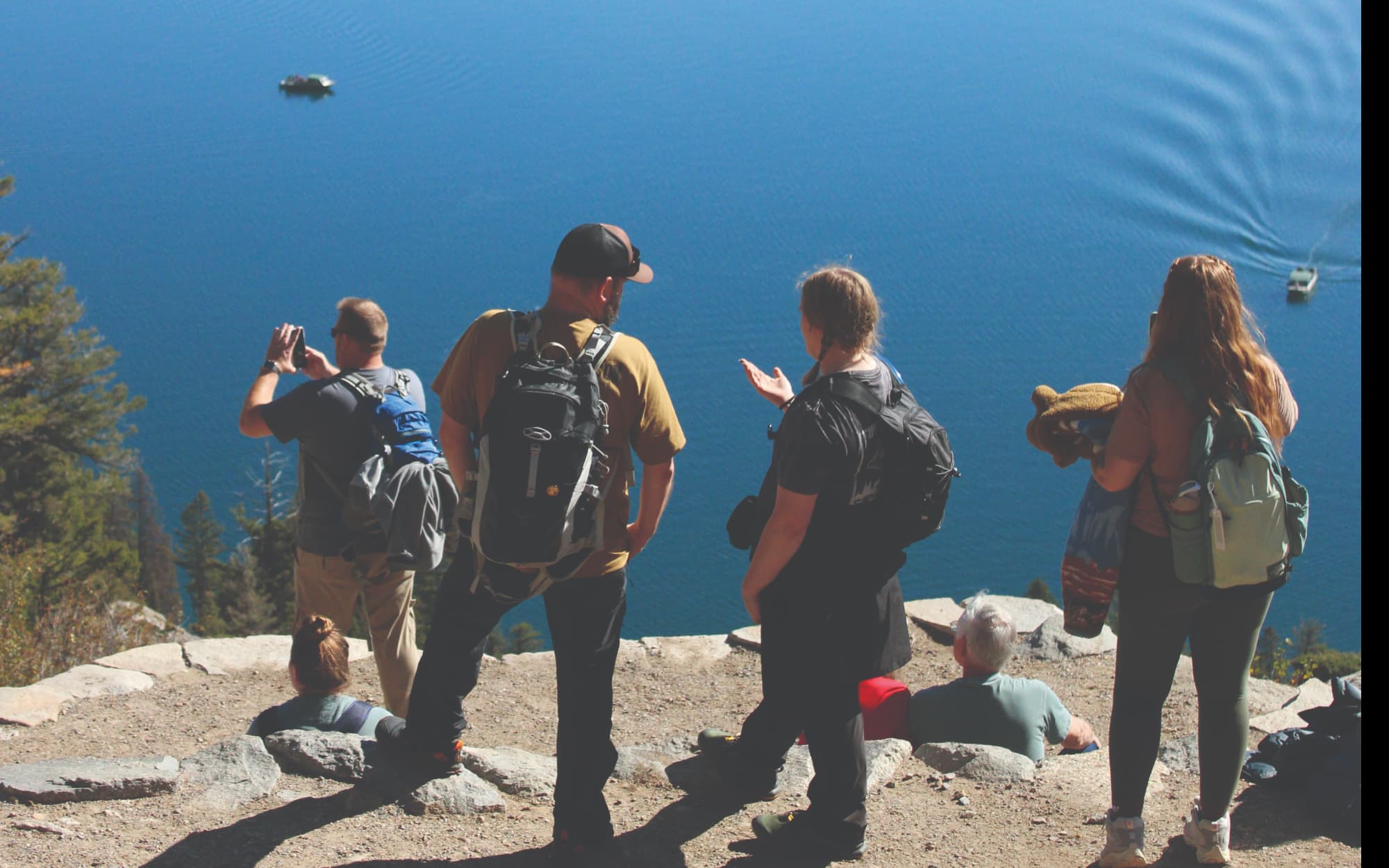
This past September, students visited the Grand Canyon, Petrified Forest, Yellowstone and Grand Teton national parks, studying ancient rock layers, volcanic activity and the forces that shaped mountain ranges. Previous classes have traveled to Colorado’s Rocky Mountains, Great Sand Dunes and Black Canyon of the Gunnison national parks. A Pacific Northwest trip is planned for fall 2027.
Abigale Riggs knows firsthand what that kind of education can mean. A UAFS geoscience graduate, she returned this fall to join the faculty as an instructor. “What attracted me to UAFS was the sense of community and support,” she says. Now on the other side of the classroom, Riggs hopes to offer students the same encouragement that she received from her UAFS mentors.
Senior Ross Bieker found his way into the program unexpectedly. Originally a business major, he switched to geoscience after an Earth Science course caught his attention. His interests deepened during trips to Michigan, where studying groundwater helped shape his plans for further studies. “I never thought I’d be doing science as a career,” he says. Now preparing for graduate school, Ross credits Testa with helping him develop his research skills and navigate applications. He also remembers visiting Carlsbad Caverns, where formations he’d studied in class suddenly made sense on a much larger scale.
The Michigan research that helped shape Ross’s plans is part of an ongoing effort involving UAFS students, Testa and the U.S. Forest Service. In the Upper Peninsula, they trace groundwater from sinks to springs, gathering information that could help scientists track pollution. They also study 400-million-year-old coral reefs and use mobile laser-scanning technology to map caves. In southeastern California, Mayo leads a research project studying an extinct volcanic field, with two scientific papers in development. His work also takes students into Arkansas to map geological faults and fractures.
These research experiences also give students opportunities to present their findings at national conferences alongside master’s and doctoral students from larger universities. Testa says students sometimes arrive unsure how their research will compare, only to discover they can hold their own. His group has recently been accepted to present at the American Geophysical Union conference in San Francisco this December.
Other experiences extend well beyond the university. UAFS senior Abigail Webb was the only student from the southern United States selected for a fully funded, eight-week research fellowship at Stanford University. There, she studied methane emissions as part of a cohort that included students from Harvard, Yale and MIT. UAFS students have also completed internships with Arkansas engineering and energy companies and worked with the U.S. Forest Service in Michigan, including a project using satellite imagery to identify sinkholes.
Discovering What’s Possible
Since 2021, sixteen UAFS geoscience graduates have been accepted into master’s or doctoral programs, according to Testa, all with tuition covered and a living stipend. They’ve pursued fields including hydrology, geochemistry, planetary geology and oceanography.
One former student stands out in Testa’s memory. The young man was taking an introductory Earth Science course and, unknown to his professor, was just a week away from withdrawing from college. Unhappy with his major, he’d begun questioning whether to stay. Testa noticed his interest and encouraged him to consider geoscience. The following semester, he placed the student in an advanced course, where he excelled. He eventually led research projects, helped other students and presented at conferences. After receiving multiple graduate scholarship offers, he chose the University of Florida, where he is completing a master’s degree in geochemistry.
Perhaps the greatest reward for the faculty comes when students recognize their own abilities. What once seemed intimidating becomes familiar, and those who hesitated to trust themselves learn to solve problems independently in the field and laboratory. With each discovery comes greater confidence, growing pride and a clearer picture of what’s possible.
Curious about geoscience and the opportunities waiting right here at home? Explore the Geoscience program at the University of Arkansas–Fort Smith at uafs.edu/programs/bachelors/geoscience.php.